

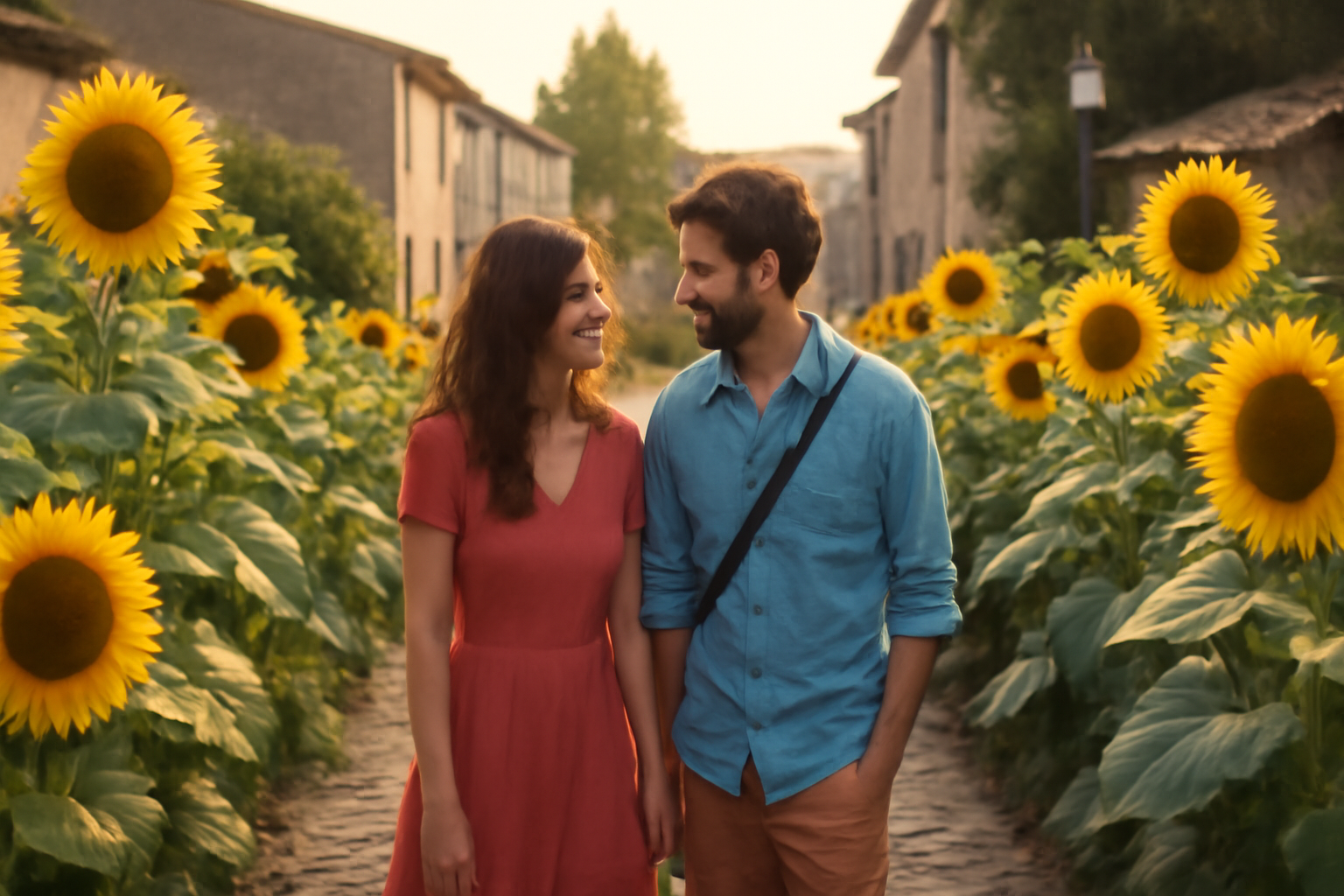
Most people arrived in Marisol Valley expecting nothing.
And somehow, they always left with something they didn’t know they needed.
Maybe it was the sunlight — the way it lingered a little longer than it should, painting the rooftops in honeyed gold well past dusk. Or maybe it was the way the hills curled protectively around the town, as if they were cupping it in gentle hands. Whatever the reason, the valley had always felt like a place where the world softened around the edges.
But no one, not the locals, not the tourists, not the mayor, not the botanists, not even the old woman who claimed to talk to her tomatoes, could explain the sunflowers.
They appeared overnight.
Every night.
And only along the main road.
Lila Cortez discovered the first blossom the summer she turned twelve. She had woken early — well, early for her — to help her mother at the bakery. The sky was still a sleepy lavender when she stepped outside, blinking at the quiet.
Then she saw it.
A sunflower, tall as she was, planted perfectly in the center of the sidewalk. Its petals were crisp and bright, glistening with dew that sparkled like stars trying to hang on.
She should’ve been annoyed. Flowers didn’t belong in the middle of walkways. Someone would trip. Someone would complain. Someone would laugh.
But instead she smiled.
Because something about that sunflower felt like a greeting.
By the next morning, there were six.
Then twenty-three.
Then an entire golden river of blossoms flowing down the main road.
Marisol Valley woke up to their presence with a mixture of awe and disbelief.
The mayor sent public works employees to remove them. They returned an hour later with two broken shovels, a sprained wrist, and a sheepish apology.
“Can’t be dug up,” the foreman said.
“Won’t be cut,” added his assistant.
“One of them moved,” whispered a third.
People shrugged.
People stared.
People accepted.
As folks in small towns tend to do when something magical happens and no one wants to ruin it by asking too many questions.
The sunflowers became a symbol — a quiet one, not plastered on tourist brochures or stamped onto tote bags. Marisol Valley didn’t brag. The flowers didn’t need bragging.
But then something even stranger happened.
The first couple to fall in love under the sunflowers did so by accident — or so they insisted when the gossip mill spun itself dizzy. His name was Mateo, a carpenter with a crooked smile and hands that smelled of cedar. Hers was Elise, a traveling watercolor artist who’d gotten lost on her way to the coast.
They collided — literally — in front of the post office. He dropped the wooden frame he was carrying. She dropped her paintbrushes. Both bent down at the same moment, bumping foreheads, laughing too loudly for strangers.
A sunflower beside them dipped its head, almost as if bowing.
Within six months, they were married.
Within a year, they’d bought a small house on Lavender Street.
Within two years, they had twin girls who smelled like sunshine.
The townsfolk nodded knowingly.
“Sunflowers got ‘em,” people said, tapping the sides of their noses.
“Perfect match,” the old woman with tomato-whispering tendencies said. “You can always tell when it’s the flowers.”
And so the legend grew.
Lila didn’t think much of it — at least not until she turned twenty-eight and came back home after ten years away. Life hadn’t gone as planned. She had imagined becoming an artist, maybe living somewhere with tall buildings or busy trains. But the world had proved heavier than she expected, and she returned to Marisol Valley with a suitcase full of unframed sketches and a heart full of exhaustion.
She stepped off the bus and inhaled the familiar smell of warm bread drifting from her mother’s bakery.
And there they were.
The sunflowers.
Taller now, thicker at the stems, petals unfurling like golden fireworks in the early morning light.
One sunflower nearest to her seemed to lean ever so slightly.
“Still dramatic, I see,” she muttered.
A soft chuckle behind her made her jump.
“Talking to the flowers?” a voice said. “Most people wait at least a few days before they start doing that.”
She turned.
Standing a few feet away was a man about her age, carrying a camera strapped around his neck, hair windswept in that annoyingly photogenic way. His shirt sleeves were rolled up, and a smear of yellow pollen dusted his cheek like war paint.
“I wasn’t talking to them,” she lied.
He arched a brow. “Sure.”
Lila felt a flush warm her cheeks. “Do the flowers still… y’know… do that thing?”
“You mean help people find their person?” he asked.
She shrugged. “I always thought that was gossip.”
“Oh, absolutely gossip,” he said. Then added, “Mostly. Probably. Hard to tell.”
He stuck out a hand. “I’m Aaron. Photographer. Passing through.”
She hesitated but shook his hand. Warm. Grounded. Real.
A sunflower beside them rustled.
“No breeze,” Aaron said softly.
Lila frowned. “They do that sometimes.”
He smiled — an earnest, hopeful smile she wasn’t prepared for.
“Maybe they like you,” he said.
Across the week that followed, Lila found herself bumping into Aaron everywhere — the bakery, the creek path, the tiny library that had somehow grown taller shelves in her absence.
Every time, a sunflower seemed to be nearby.
Every time, it seemed to watch.
One evening, under a pink-orange sunset, Aaron walked with her down the main road, the sunflowers glowing like lanterns.
“You know,” he said, “I didn’t come here for a story.”
“No?” she asked.
“No. I came here because I kept seeing this place in my dreams.”
He laughed quietly. “Sounds ridiculous, I know.”
“Not here,” she whispered.
He stopped walking.
“So what about you?” he asked. “Why’d you come back?”
Lila swallowed. “Because sometimes the world is too big, and I needed something small again. Something that felt like it remembered me.”
A sunflower beside them bowed slightly.
Not wind.
Not coincidence.
“Lila,” Aaron said, voice softening, “maybe you came back because something — or someone — was waiting.”
She looked up at him.
And for the first time in a long time, she didn’t feel lost.
She felt found.
A warmth spread across her chest, deep and steady.
And in that moment, every sunflower along the road bloomed — all at once.
A rush of golden petals unfurled, bright as laughter.
Lila gasped.
Aaron exhaled.
The entire town glowed.
They never announced anything.
But the sunflowers did.
Every morning afterward, Lila found a new blossom outside her window.
Every morning, Aaron found one growing near his porch.
Every morning, they walked the main road together.
Some things don’t need explanations.
Some things don’t need legends.
Some things simply are.
And in Marisol Valley, where sunflowers grow overnight and hearts bloom quietly beside them…
Love is just one of the small miracles.